
Archive for the ‘Current Events’ Category
Lance: He’s Back?
There are news reports that Lance Armstrong is considering coming clean and admitting that he doped. Back in October I speculated that this might happen, and at least some of this may be about his desire to compete in high level triathlons. As I think more about it, the average observer may not be fully aware that a subset of super-elite athletes really “needs” the combination of fame, glory, money, and adrenaline that comes from being at the absolute competitive edge. My bet is that Lance is thinking that with a suspension lasting between 2-4 years he would be back by his middle 40s with just enough “physiological time” left to win the Ironman. It would be a stretch, but some folks in their early 40s have done very well at that distance and it is certainly not physiologically impossible. If Lance did it, he would get everything he seems to crave…… at least for a while.


Longevity and the Retirement Age
Much of the long term pressure on the finances of the Federal Government is being driven by rising expenditures on health care and pensions and much of this is being driven in turn by an aging population. This has led to proposals to raise the retirement age especially for Medicare. You will likely be hearing more about the retirement age as our political “leaders” try to figure out what to do next in terms of taxes and spending.
Here is a proposal from the conservative Heritage Foundation on this topic, but they are not alone and many “centrist” groups are proposing increases in the retirement age for Medicare. This idea has been criticized by people like the economist turned political commentator Paul Krugman as unfair because the increases in overall longevity in the U.S. have been uneven and not shared by all socioeconomic and racial subgroups in the country. Today I want to take a deeper data driven dive into this topic.
1. The big picture. In an earlier post on longevity I pointed out that in 1960 about 60% of men and 71% of women lived to age 65. The men who made it to 65 then lived an average of about 13 years and the women who made it to 65 lived another 17 years. In 2010 about 84% of men and 89% of women made it to 65. The average man who makes it to 65 now lives another 16-17 years and for women it is about 19 years. These changes are being amplified by the fact that the leading edge of the baby boom generation is reaching retirement age causing a further bulge in the aging population. You don’t have to be a rocket scientist to realize these demographic trends are putting pressure on Federal finances.
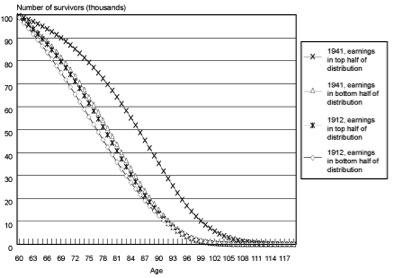
2. Differential Increases in Longevity and Socioeconomic Status. I mentioned above that critics of the idea of raising the retirement age for Medicare point out that most of the gains in longevity have been in people that are relatively well off. The graph below is from a study by the Social Security Administration and shows survival curves starting at age 60 for men comparing those born in 1912 with those born in the 1941. The key observations are that: a)in 1912 there was not much difference in life expectancy between the top and bottom half of income distribution, b) the bottom half of the 1941 cohort does not look that different than either group from 1912, and c) that life expectancy at age 60 has really gone up for the better off men born in 1941. There are lots of ways to slice and dice data like this but pretty much every way you do it comes out the same and gains in life expectancy have been greater for people who are better off.
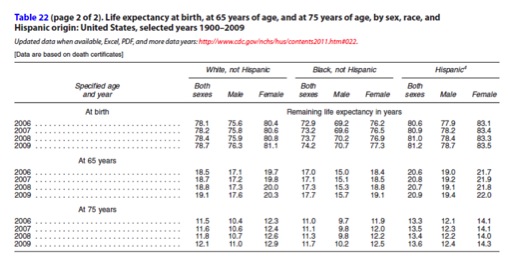
3) The race and education snapshot. Below are a table and graph from summary data from the U.S. Centers for Disease Control in 2011. The table shows life expectancy at birth, 65, and 75 in recent years. What is interesting here is that the differences in life expectancy between Blacks and Whites at 65 and especially 75 are much lower than the projected differences at birth. The other interesting thing to note is that Hispanics are higher than either Blacks or Whites in all of the major comparisons. I interpret this in a couple of ways. First, a big issue here is not what happens once people reach the standard retirement age of 65, but what is happening prior to age 65 especially in Blacks. The other issue here is that women do better than men and I have not heard any of commentators claim that raising the retirement is unfair to men.
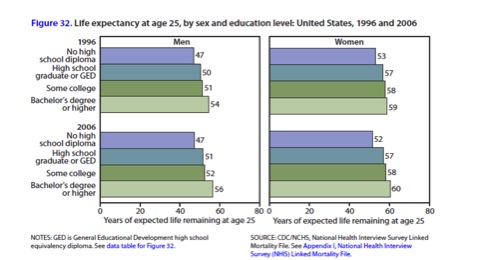
The next figure shows life expectancy at age 25 in 1996 and 2006 by education level and sex. This table shows a couple of things including: a) educated people live longer and there is a dose response curve, and b) life expectancy at age 25 for less educated people has stagnated. This figure also shows that women live longer than men at every level of education.
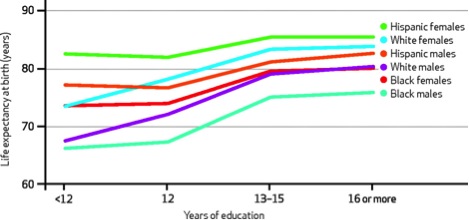
4) A summary slide. The figure below is a summary slide that shows the effects of race, sex, and education on life expectancy at birth. These differences would likely exist at age 65 but be much smaller in terms of absolute years. The article this figure was taken from indicates that some of these differences might be getting worse.
My take on all of this data. There are all sorts of ways this data can be analyzed. For the purposes of thinking about the retirement age a couple of things stand out.
- People as a whole are living longer but the gains have been uneven and influenced by sex, education, and race. There are also probably pretty tight relationships between race, economic well-being and education.
- A lot of the problem is not about what happens when people reach age 65, but what happens before age 65. People with lower socioeconomic status tend to have a host of behavior and risk factor issues that negatively influence their ability to make it to 65 and then do as well after age 65. So the real issue here is how to address health disparities vs. the fairness of raising the retirement age.
- Many of the factors leading to health disparities like differential smoking rates, obesity, lack of physical activity, and violence have little to do with what we think of as traditional health care and will not be fixed if and when high quality health care is available to all.
- There is also an argument that people are retiring too early for economic reasons and that a lot of people are financially unprepared for the long life they are likely to live in retirement. If raising the eligibility age for Medicare encourages people to work longer, maybe that is good for their own long term economic well-being as well as that of the country as a whole.
Closing comments. The discussion about the fairness of raising the retirement age for Medicare has been marked by incomplete thinking about the data and is confusing the very real problem of what to do about health disparities based on race, education, and sex with the arithmetic of Federal finances. Some of this discussion is being led by people with overtly political and personal agendas like Paul Krugman (who should know better) at the expense of a hard look at the facts.
Mastery for New Years?
In the Thanksgiving and Christmas posts I focused on optimism and mindfulness. For New Years I want to focus on the complementary concept of mastery. Together they operate like a “three legged stool” and can provide a balanced approach to almost any challenge.
Benny Goodman (1909-1986) was one of the all-time great clarinet players. He was also a leader in the emergence of jazz as a respected and mainstream art form. Beyond that he integrated his band in the 1930s more than 10 years before institutions like professional baseball or the U.S. military were integrated. Underneath all of this innovation and personal excellence was an obsessive devotion to practicing the fundamentals of the clarinet. In fact, during the 1950s at the height of his fame, Goodman started taking lessons again to improve elements of his playing so he could master classical music as well as jazz. How many of us who are really skilled and famous at something would seek out a teacher or coach to branch out and get better in middle age? One overriding lesson in all of this is that Goodman’s mastery of and focus on the basics served as a platform for him to break new ground and take chances in multiple arenas.
The clip below shows Goodman and his band playing “Sing, Sing, Sing” in the late 1930s as part of the movie “Hollywood Hotel”. Note how relaxed he and the band are. Note that he lets the great drummer Gene Krupa and trumpet player Harry James get plenty of attention. At the end of the clip he is playing with the equally gifted Lionel Hampton and Teddy Wilson who were black which would have been inconceivable pre-Goodman.
click here for video
Are there larger lessons from Benny Goodman? It seems to me that we have entered into a world of mindless standardization and metrics that inhibit change in the name of stability and predictability. Our ability to measure all sorts of things that might be called outcomes and then manage the world in an effort to get more of the “desired” outcomes in a sort of linear way has never been greater. However, life is unpredictable and perhaps what is missing in all of these metrics is the recognition that improvisation and novel solutions are what move our messy world forward. So, do we mindlessly focus on metrics or do we use metrics as a way to ensure we have mastered the fundamentals of whatever we are doing? We can then use our mastery as a platform to innovate and take chances like Goodman did.
Perhaps the best example of metrics gone bad comes from the Vietnam War when things like body counts were used by Secretary of Defense Robert McNamara as a substitute for insight about the nature of the war. If you want to see a chilling example of a leader who does not understand the importance of culture and the non-rational elements of life, the documentary film “Fog of War” by Errol Morris is an extended interview with McNamara at the end of his life. He went to his grave not getting it and thinking that everything could be subject to metric driven analysis and decision making.
On the flip side is the W.L. Gore Company that makes Gore-Tex and other interesting products. Gore has rejected the top-down metric driven world view and things like economies of scale. Instead they focus on a few key values and trust their employees to move the company forward. They keep their work units small (less than 200 people) and intimate on purpose. One size rarely fits all and this idea is now getting more play by the people who study long term organizational success. Mindless adoption of best practices merely accelerates the arrival organizational monocultures and dogma that limit our ability to adapt to rapidly changing circumstances. In medicine many of the key guidelines and best practices I learned in the 1980s and 90s have been turned on their head. Best practices are only best for now.
What would Benny say? The clip below is from an interview Goodman did late in life with Diane Sawyer……my take on what he said is that it is all about mastering the fundamentals to do unique and challenging things. Being a slave to metrics and standardization are easy and tempting ways to limit your ability or the ability of your organization to move forward. The next time you hear someone tell you they are managing to metrics, ask them what they might be missing!
http://www.youtube.com/watch?v=aO8bxTttdQ4
click here for video
Indoor Exercise: Tips for the New Year!
This is the time of year where people in colder climates do more indoor exercise. People also make New Year’s resolutions to get in shape. Some serious athletes use indoor training year round because it is possible to better control the exercise intensity and the overall effort of the training session on a treadmill or bicycle ergometer. All of this is easier now than it was 20-30 years ago before the widespread availability of well-equipped fitness centers.
However, indoor exercise can be boring and it is easy to lose fitness this time of the year. Getting to the gym can be a hassle and short days along with the urge to sort of hibernate during the winter can make finding time to train a bit harder. So the question is how to get the most bang for your training buck until it gets warmer and the days get longer?
One thing I do is interval train on the Treadmill 2-3 times per week. I start slowly about 6.1 miles per hour (mph) and then use a saw tooth pattern of increasing speed. I go up 0.5 mph on the even numbered minutes and down 0.2 mph on the odd numbered minutes. After about 10 minutes I get to a pace of around 7.7 mph and then do 10 repeats of 1 min at 7.7 mph followed by two minutes of running in the 8.5-9.5 mph range. The goal is for each of the two minute repeats to be at a faster speed. In interval training lingo that is known as “descending” the workout. A Lot of times I increase my pace by 0.1 mph every 10 breaths, so I pick it up during the fast part of the cycle. Counting your breaths is also a good way to learn to relax while you are running fast. Using this pattern, the first mile is almost exactly 9 minutes and then I try to do a bit over 4 miles in the next 31 minutes. The total session takes 40 minutes.
Along these lines there is an excellent recent paper from colleagues in Denmark on the efficacy and efficiency of this type of training strategy. They asked moderately fit people in their 30s who had been running about 15-20 miles per week to either keep doing more or less the same thing or do three sessions a week of interval training for seven weeks. The intervals consisted of three or four 5 minute intervals with two minutes of jogging in between. However, during the fast part of the intervals low-, moderate-, and high-speed running (<30%, <60%, and >90% of max) for 30, 20, and 10 seconds was used each minute. This is pretty complicated to describe but the figure below shows a typical heart rate pattern for such a training session. The heart rate shown with dashed lines is higher during 5 minute intervals and lower during the recovery period than during a steady state training session shown with the solid line. The slight variations in heart rate during the intervals are due to the 30-20-10 changes in running speed.
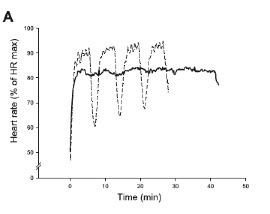
Key findings included:
- The interval training group reduced training volume by 54% (14 vs. 30 km/wk about 9 vs 18 miles/wk) while CON continued the normal training.
- After seven weeks VO2max (a key marker of fitness), and performance in a 1,500-m and a 5-km run improved by 21 and 48 s, respectively.
- Blood pressure and cholesterol values also improved more in the interval training group.
The authors concluded that:
“The present study shows that interval training with short 10-s near-maximal bouts can improve performance and V̇O2max despite a ∼50% reduction in training volume. In addition, the interval training regime lowers resting systolic blood pressure and blood cholesterol, suggesting a beneficial effect on the health profile of already trained individuals.”
Summary
Relatively brief but high intensity interval training is a great way to maintain and even improve your fitness in the winter. For people with competitive goals it means that you will be ready for more and harder training as the days get longer and warmer and you head outside in March or April. There is also a growing body data about the value of higher intensity exercise for people of every ability level and age group. A New Year’s resolution that includes interval training might be a good way to start.
Mindfulness for Christmas?
In my post around Thanksgiving I made the case for optimism as a justifiable approach to the world. The general idea is that many things have gotten better and many seemingly unsolvable problems have been addressed in the last 40 or so years. Part or my motivation was reminding people that life goes on and things frequently get better no matter how crazy the world seems at any given moment. In the past few weeks a number of things have led me to think that optimism and something called mindfulness go hand in hand.
First, what is mindfulness? One way to look at it is just simply paying attention or being more engaged in what you are actually doing. In other words stop distracting yourself. Tough to do in a world full of electronic and other goodies and interruptions. Based on personal experience and chatting with others, I think a major reason people who are committed exercisers stay with it is because their exercise time is something they “own” and includes a chance to focus and get into what is usually called the “zone”. The elite athletes do it and so can you. When it happens you too can be a religious mystic………
Below is a little brain candy about mindfulness that you can give yourself for Christmas:
- Here is a link to an interesting article on mindfulness and the need to sometimes let things percolate. There is a saying in medicine “don’t just do something stand there!” Wise advice to consider before you push the overreact button, or respond too quickly to an irritating e-mail. There is no retrieve button, and part of life is learning what to ignore.
- The book ”Finding Flow” has a number of ideas about how to get more “Flow” into your life. From what I can tell flow, mindfulness and the zone are different names for the same thing. A quick summary might be the internal satisfaction associated with engagement in a challenging activity and doing it well for its own sake independent of an external outcome. Not too different from the definition of success and other ideas promulgated by legendary basketball coach John Wooden. Wooden learned in his early 50s that shorter practices devoted almost exclusively to a limited number of fundamentals and simple plays paradoxically made his teams better. At the same time he stopped scouting the other team preferring instead to devote his energy (and the energy of his team) to what they had total control over…….their focus, effort and execution. Coach Wooden had learned to ignore or maybe how to focus by ignoring.
- There are some good resources about how to use what might be called micro breaks to do a little deep breathing and refocus throughout the day. My colleague and collaborator John Schmidt, a psychologist at the University of Pittsburgh, has used these techniques to help people with chronic pain move forward and get more out of life. John tells me they can work for us all and he recommends the short book “Wherever You Go, There You Are”. Here is a handout he uses with his patients.
- In some of my posts around the Olympics I highlighted what the great coaches know and how they help the athletes they supervise “relax and win”. In other words put forth seemingly super human efforts effortlessly. These very same approaches can help us all.
- My friend Terry Laughlin, who is one of the great coaches, has two interesting recent posts on his blog. One is related to mindfulness, adult learning and successful aging. Terry started off many years ago trying to help people swim faster and now he helps them understand that the fastest swimmers swim slower (fewer strokes to cross the pool) using less force. His second post is about how a video of one of his disciples became the most watched swimming video ever. In e-mail conversations with Terry he has taught me that to streamline your swimming stroke you must first streamline your mind (just like Coach Wooden streamlined his approach). Perhaps there is a more general principle here to streamline your life……your organization……your whatever, perhaps you must first streamline your own mind.
So maybe give yourself the gift of mindfulness this Christmas. And remember the words of Antoine de Saint-Exupéry who wrote the “Little Prince” and was also a pioneering aviator. His advice below might seem counter-intuitive, but less truly is frequently more and the examples highlighted above are just a few that prove the point. Enjoy the process of streamlining your mind in 2013.
“…perfection is finally attained not when there is no longer anything to add, but when there is no longer anything to take away…”
On Killing
The massacre of first graders in Newtown, Connecticut along with other recent mass shootings is going to re-start the discussion on gun-control and violence in the United States. When people ask me what I think about these topics, I tell them to read the books by Lt. Col. Dave Grossman, who is both a paratrooper and Ph.D. psychologist and wrote the classic book “On Killing” in the 1990s. Grossman essentially predicted and explained how and why these tragedies happen. Grossman also has a website on “killology” that offers resources to prevent and deal with these catastrophes. Here are some caveats I have gleaned from following Professor Grossman’s work over the years.
- Many of us are far removed from death and killing by modern society. We have never killed anything, butchered the meat we eat, seen a person die either slowly at the end of life or violently in an accident or conflict.
- Without direct experience what we know about death and violence comes to us indirectly via the media. So we experience a false version of violence via cartoons, in action movies or video games for example. Whatever the source, it is a caricature of real violence and death. This experience of pseudoviolence also sends us messages about the role of violence in problem solving (e.g. kill the bad guys) and personal empowerment.
- Most humans are extremely reluctant to kill and have to be trained or desensitized to do it. Grossman sees parallels between video games and techniques used to train soldiers to kill in combat. These are classic psychological conditioning paradigms designed to reward a specific behavior and overcome inhibitions.
When you add all of the above together and put real firepower – assault weapons, high capacity ammo clips, and specific types of bullets — in the hands of an unbalanced person you can get a volatile mix that ends in tragedy. Here is a link with statistics on the larger issue of gun deaths in the United States. Gun deaths are almost as common as traffic fatalities. Clearly we should be able to come up with laws and regulations that protect the rights of hunters and sportsman but at the same time limit gun violence and gun deaths in the U.S. Through regulation we have reduced yearly traffic deaths by about 40% and deaths per passenger mile driven by about 90% since WW II. With a little common sense and we could probably do the same for gun deaths in the U.S. in a way that protects the rights of responsible citizens to own weapons. Whatever you think about gun control, the work of Dave Grossman offers real insight into the magnitude and many facets of the problem exemplified by Newtown. I urge you to read his work so you can contribute to the discussion in a thoughtful way.
Gridlock vs. Brainlock in Washington?
Why there is so much political gridlock in Washington related to the country’s finances?
It is pretty clear that there are plenty of policy solutions out there. Here is information from the Peter G. Peterson Foundation Solutions Initiative. This comes from a program in 2011 that asked six think tanks across the political spectrum to suggest approaches to the long term financial challenges facing the United States. So, the first thing everyone needs to recognize is that there are plenty of ideas out there.
Then why are our political leaders having so much trouble finding middle ground, compromising and “cutting a deal”? The standard arguments go something like this:
- The country is more polarized than ever so there is little middle ground.
- There are not enough moderates in either party who can cross party lines to make a deal happen.
- There is a media echo chamber so that each side has their position constantly reinforced.
- The current political leaders lack the political and negotiating skills that were once common in Washington that made deals possible.
I have another take and it comes from brain scanning studies and what parts of the brain are activated in people who are interested in politics. A technique called functional MRI is used in these studies. Here is a summary of the results from one such study:
“Using functional magnetic resonance imaging (fMRI), we scanned individuals (either interested or uninterested in politics based on a self-report questionnaire) while they were expressing their agreement or disagreement with political opinions….Behavioral results showed that those political opinions participants agreed with were perceived as more emotionally intense and more positive by individuals interested in politics relative to individuals uninterested in politics. In addition, individuals interested in politics showed greater activation in the amygdala and the ventral striatum (ventral putamen) relative to individuals uninterested in politics when reading political opinions in accordance with their own views. This study shows that having an interest in politics elicits activations in emotion- and reward-related brain areas even when simply agreeing with written political opinions.”
The take home message for the authors was that:
“…..increased amygdala activity in individuals interested in politics for political opinions in accordance with their views may be related to an increased emotional intensity associated with the sense of belonging to a social group and/or the importance of their beliefs to constructing a positive sense of self.”
If you think about these results and the explanation above, perhaps they explain why it is so hard to compromise and negotiate. Activation of emotional parts of the brain might make it hard to get past your own world view. There are other interesting findings about how brain structure differs in conservative vs. liberals and how they process political information differently.
Finally, motivated reasoning is a term used to describe biased information processing when people have an emotional stake in the outcome. It is interesting to note that there is also brain imaging evidence to suggest that political thinking activates specific areas of the brain involved in motivated reasoning distinct from the areas involved in cold or unbiased reasoning.
Based on the ideas presented above it seems to me the issue in Washington is Brainlock and not Gridlock. I wonder if there are training programs or other techniques that politicians and pundits on both sides could use to increase their mental flexibility.
Progress Against Obesity?
The obesity epidemic and what to do about it has been a major focus of this blog. Plug in OBESTIY to the key word search tool and a large number of links show up on many elements of the obesity problem. Except for the ideas that exercise can modulate the negative health consequences of obesity, limit the impact of obesogenic genes, and play a key role in helping real biggest losers, there is not a lot of good news on the obesity front.
However, there were reports earlier this week that childhood obesity is dropping in some cities in response to comprehensive nutrition and physical activity programs. Here is a link to a longer report from the Robert Wood Johnson Foundation. The report concludes:
“Growing evidence suggests that strong, far-reaching changes—those that make healthy foods available in schools and communities and integrate physical activity into people’s daily lives—are working to reduce childhood obesity rates. More efforts are needed to implement these types of sweeping changes nationwide and to address the health disparities gap that exists among underserved communities and populations.”
There are also new ideas about how social media might be able to help fight childhood obesity. This is an important idea because evidence from the Framingham Study shows that weight gain in our friends is a critical risk factor for weight gain in us! They followed social connections between and among about 12,000 people for over 30 years and found that:
“Discernible clusters of obese persons (BMI>30) were present in the network at all time points, and the clusters extended to three degrees of separation. These clusters did not appear to be solely attributable to the selective formation of social ties among obese persons. A person’s chances of becoming obese increased by 57% if he or she had a friend who became obese in a given interval.”
The idea is that the same social forces that make obesity “contagious” might also be used to make healthy choices and behaviors contagious. There is also increasing evidence that food pricing strategies (e.g. sugar and fat taxes) will work to improve nutrition and combat obesity especially in low socio-economic groups. This is important because these groups have been relatively resistant to other public health efforts directed at obesity.
When you look at the data and ideas described above and discussed previously, it seems to me we need to do the following to turn the obesity epidemic around:
- Adopt the strategies outlined in the Robert Wood Johnson Report nationally. Like smoking, if we stop obesity early in life it will pay off in middle age.
- Develop comprehensive programs to promote physical activity. Some of this is about urging people to exercise more. Some of this is about urban design and planning to make the world friendlier to physical activity. Most of us live in places that are car friendly but not walking or biking friendly. This is critical because weight loss is hard and physical activity can prevent weight gain, help with weight loss, and blunt the negative health consequences of obesity.
- Increased public education programs.
- Interventions that increase the cost and/or reduce the portion size of obesogenic foods like sweetened beverages. This would include so-called sin taxes.
- Use social networking tools to define what is normal and reduce the “contagious” elements of obesity. They could also be used to increase the contagious elements of fitness and normal body weights.
Summary: the news on obesity is not all bad and strategies that work are beginning to emerge. If they are applied widely over the next 20 or 30 years perhaps the obesity epidemic can be stopped. It is a matter of both our individual and collective cultural will power.
You are currently browsing the archives for the Current Events category.
LIKE MIKE

SUBSCRIBE TO RSS
