
Archive for the ‘Current Events’ Category
Why Did Lance Throw In The Towel?
I want to follow up on Friday’s post on Lance Armstrong abandoning his legal challenges to United States Anti Doping Agency (USADA) case against him. Armstrong has a “take no prisoners” reputation and the question on everyone’s mind is why the ultimate no quit person, quit? Here are some thoughts:
- Once his legal challenge in U.S. federal court was rejected he could no longer play offense and essentially put USADA on trial. This means that he could no longer control the process and expose the limitations of drug testing and use the idea that he was targeted for extra testing to his advantage.
- Cycling has had a doping problem for a long, long time and at some level he likely believes that all he was doing was ensuring he and his team had a level playing field. Here is a link to a graphic on recent doping bans in the Tour de France. Lance was not alone, and I bet he feels like whatever he did it was more than justified. It reminds of a quote by Vito Corleone in the Godfather:
- Bill Katovsky sent me a something from Slate.com about how Lance can continue to be outraged and point to the many drug tests he passed and the fact the Feds did not indict him after a two plus year investigation. Again, who cares what USADA says, he controls the story.
- Battle fatigue associated with constantly being investigated. Mitch Jackson an attorney from Southern California sent me this e-mail and also commented on Friday’s post:
“Litigation can be a nightmare… even for those people who have done nothing wrong. I have no idea what Lance did or didn’t do but even though I have 27 years of successful litigation experience under my belt, I think the last thing I’d want to do is try and defend myself overseas in this particular arena on this particular issue.”
- Lance looked at it objectively and figured a small percentage of people really care about the details of what did or did not happen with doping in his tour victories. The average person looks at it a bit like professional wrestling and all they care about is the uber narrative of Lance as heroic cancer survivor. In the long run his brand depends on this and he can go on being rich and famous and doing good things for the world at large no matter what USADA says. The support shown by his sponsors is consistent with this interpretation. So the smart move was to punt.
- The sportscaster Seth Everett sees the whole doping story in the context of brand protection by the leagues and international federations and likens it to the speed limit. Without drug testing everyone is trying to go 80 when the speed limit is 65. With doping control most people go 65 and a few can get away with going a few miles an hour over the speed limit.
- About my idea that a “Truth Commission” might used to change the culture and get to the bottom of the doping problem, reaction was mixed. Gretchen Reynolds gave it a positive Tweet, but George Brose who runs a great website on old time track and field felt that Truth Commissions were best used in situations associated with true evil like Rwanda. I still think a Truth Commission should be explored. The current system is not working and until someone gets to the bottom of the doping culture, the cat and mouse game will continue.
I think the seven points above cover most of what has or has not been said about the Lance situation. Life will go on for us all, the doping circus will continue and from my perspective a number of things that could have been done to make things better and learn from this and other doping situations have not been done. Next week, the plan is to refocus on issues related to exercise, health and how to make life better for the rest of us.


Lance Armstrong: What Really Happened – Spreecast with Seth Everett
I had a great time today participating on a Spreecast with Seth Everett to discuss the recent news on Lance Armstrong.
http://www.spreecast.com/events/lance-armstrong-what-really-happened/embed-large
Lance Throws In The Towel
Who would have thought that Lance Armstrong would throw in the towel in his drug case? Last month I briefly reviewed the pros and cons of the case and I was waiting for things to heat up in the next few months before I commented again. The pro Lance arguments go:
- He passed a gazillion drug tests.
- The federal investigation of him was abandoned making many people think there was no clear money trail that could be followed to support allegations of doping. Systematically beating doping control with blood transfusions is logistically complicated and can’t be cheap. So if the feds could not find a money trail maybe there wasn’t one.
The anti Lance arguments go:
- The drug tests are beatable (ask Marion Jones). So passing drug tests proves nothing.
- How could he dominate for so long and in many cases so decisively in a sport where a high percentage of the people he was beating were actually caught doping?
- Some of the power outputs that top people were doing during mountain stages in the Lance era are at the edge of what might be physiologically possible and are probably physiologically impossible.
- Rumors, rumors, rumors, rumors and would a guy like Lance ever “unilaterally disarm” if he thought the rest of the world was doping?
Here is what I thought might happen that did not. I expected a federal judge to rule that United States Anti Doping Agency (USADA) was essentially an arm of the government. As an arm of the government USADA needed to follow certain standards of due process and that they were not. Lance then gets USADA in court and forces them to admit the limitations of drug testing and that he passed a bunch of tests even though he had been targeted for extra testing. There are also a number of credible expert witnesses who could easily have shot holes in some of the blood count numbers that USADA had deemed suspicious.
So then it would have been about what his ex-teammates were willing to say and how all of it sounded to a jury. A good lawyer could have had a field day. A star struck jury buys the arguments Lance and his team make and it is Lance 1, USADA 0.
For the younger people reading this post I thought of one precedent, Tarkanian vs. the NCAA, and have been surprised that no one in the mainstream media has made the connection. The basketball coach Jerry Tarkanian was in essentially a 20 plus year range war with the NCAA about claims of recruiting and other violations in the high profile college basketball programs he ran. He sued using some of the rationale I outlined above and eventually the case went to the U.S. Supreme court. Tarkanian lost there, but he was never banned from coaching and won a settlement from the NCAA based on claims that they were persecuting him. A lot of parallels with what might have happened had Lance pressed on.
Another issue that has been largely ignored by the mainstream media is how the whole issue of doping in sport, especially cycling, might have been handled differently. One idea is that there should have been a truth commission. In other words let everyone come clean, tell what they did, name names, and try to learn everything there is to learn about both the technical and cultural aspects of doping. Don’t strip anyone of medals or titles but get the truth out and improve the testing and compliance programs. Only go after the people who refuse to come clean.
The truth commission approach has been used to promote social reconciliation in places like post apartheid South Africa. Maybe it could have been used to clean up high level sport as well.
There is more than one way to define a level playing field, and in this era of rampant doping the athletes and those around them have been trying to define it themselves. Failing to use the truth commission or a related approach means that the cat and mouse enforcement games go on and that it is just a matter of time until there is another Marion Jones or Lance Armstrong. I believe the athletes want clean competition and that the key to this is fixing the culture which will require more than better drug tests.
Inactivity and Obesity
This post is on how inactivity is a major player in the obesity epidemic. It is data rich so fasten your seat belts. That having been said, I want to make three main points:
- Physical inactivity is an extremely recent experience for humans as a species.
- People with high levels of physical activity are protected from obesity.
- A loss of physical activity at work as we all become desk jockeys is a big reason why we are getting fatter as a population.
Inactivity is recent.
Dates vary but modern humans emerged out of Africa and began to spread to the rest of the world about 40,000 years ago. For the next 30,000 years essentially we were all hunter gatherers. Based on a variety of estimates, including observations in the few remaining hunter gatherer societies, it appears that many adults hunter gatherers walk between 10 and 20km (6-12 miles) per day. There also appears to be essentially no obesity in these societies. There are complex potential interactions between their activity levels and what they were eating, but many groups of hunter gatherers had access to plenty of food. Granted the variety might have been minimal, but for many there were plenty of calories.
About 10,000 years ago agriculture emerged during something called the Neolithic Revolution. We have at least some idea about the activity levels associated with muscle power (human or draft animal) farming from the Old Order Amish who practice agriculture without the benefit of electricity or tractors but do use horses! It is also pretty clear that they eat an awfully lot of what could be called traditional high calorie farm food. Here is a quote from adapted a classic study on the Old Order Amish.
“The average number of steps per day was 18,425 for men versus 14,196 for women. Men reported 10.0 hours per week of vigorous physical activity, 42.8 hours per week of moderate physical activity, and 12.0 hours per week of walking. Women reported 3.4 hours per week of vigorous physical activity, 39.2 hours per week of moderate physical activity, and 5.7 hours per week of walking. Men had higher levels of energy expenditure than women. A total of 25% of the men and 27% of the women were overweight (BMI > or = 25), and 0% of the men and 9% of the women were obese (BMI > or = 30).”
High levels of physical activity protect against obesity.
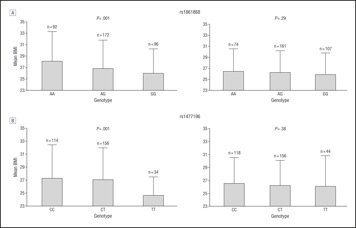
The data above mean that most Old Order Amish are essentially physically active all day long most days. Contrast their BMI values with the values for the U.S. population as a whole that I reviewed earlier this week, 35% obese and 60-70% overweight. Another interesting thing about the Old Order Amish is that their high levels of activity protect them from two gene variants that seem to predispose sedentary people to higher BMIs. The left panels on the figure below show that for Old Order Amish in the bottom 50% of physical activity there is a relationship between the gene variants and BMI. The right panels show that for those in the top 50% of physical activity there is no relationship between the gene variants and BMI. Genetic predispositions get blamed for all sorts of things but the environment, culture and lifestyle typically has an even bigger role for most common conditions. Again high levels of physical activity are protective against obesity.
Physical activity at work matters.
The Old Order Amish are people who are clearly active all day long with farming and household chores. They are probably as active or even more active than hunter gatherers were. However, in the last hundred years a muscle powered way of life has vanished for most of us. So, what about the rest of us? It turns out that over the last 50-100 years most of us are doing less and les physical activity at work. The slide below is from a terrific scientific paper on this topic. It shows that as over the last 50 years the number of people employed in jobs associated with moderate physical activity has declined from about 50% to 20%. As the authors note:
“From 1960 to 2008 there was an approximate drop in occupation-related daily energy expenditure of 140 calories for men and 124 calories for women.”
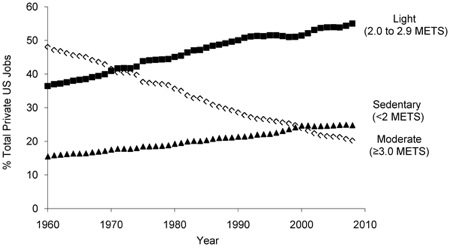
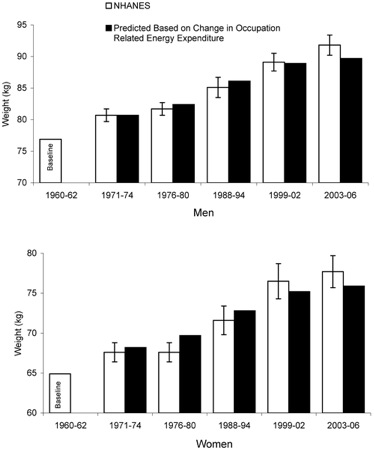
For most of us that is like walking (or not walking) 1 to 1.5 miles during the day. What is even more amazing is how these missing calories add up and explain population based weight gain over the last 40 or 50 years. The figure below also from this paper shows the impact of the missing calories on estimated changes in body weight over time and how the match up with the NHANES population surveys in the U.S. It is incredible how well the numbers match up. It is also incredible what a big impact just over 100 hundred calories a day has.
Summary
Hunter gatherers and traditional farmers were very active and almost none were fat even when there was plenty of food around. However, you don’t have to be that active to avoid the being a statistic in the current obesity epidemic. The data on occupational energy expenditure from the last 50 years shows that burning an extra 100-150 calories a day can have a huge impact on population based body weight statistics. From a practical perspective what would happen if everyone went for a brisk 20-30 minute walk at lunch every day?
Defining Obesity
This is a short post with some definitions and statistics about obesity. They will be helpful to understand upcoming posts on the health consequences of physical inactivity and how inactivity and obesity are linked.
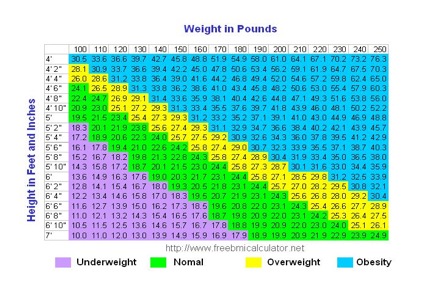
First, what is BMI? BMI stands for Body Mass Index. It is a mathematical formula that factors in height and weight to give a single number that is useful to normalize values for people of different heights. This link is to a CDC site about obesity and BMI. Briefly, a BMI of 20-25 is normal, between 25 and 30 is considered overweight, and more than 30 is obese. BMI is not a perfect way to estimate body composition, for example there can be super muscular people who have high BMIs and are very lean. However, for the population as a whole it seems to work. Here is a link for anyone who wants to take a deeper dive into BMI. Using the table below you can calculate your own value. For anyone used to the metric system the table is in feet and pounds because most of my readers are likely in the U.S.
Second, just how fat are we getting as a population? In the last couple of posts I have talked about the pandemic of inactivity related diseases and just how inactive most people are. Below is a CDC video showing the trends in obesity by state in the U.S. over the last 30 years. You can see there is also an obesity epidemic going on in parallel with the inactivity problem and about 35% of the U.S. population is now obese and somewhere between 60-70% are either overweight or obese. The CDC website has more data on obesity for those who are interested.
click here for video
The data and video speak for themselves and there is no need for much editorial comment except to say it is a very, very disturbing situation. In coming posts I will make the case that less physical activity has caused this problem and that more physical activity and exercise are key to addressing it.
Physical Activity: Are We Getting Enough?
A couple of days ago I discussed whether deconditioning should become a distinct medical diagnosis because it is the root cause of so many devastating chronic diseases. In this short post I want to briefly review how much structured exercise or physical activity is enough and whether people are getting enough?
First, let me briefly comment on exercise and physical activity. They are related but not exactly the same thing. Structured exercise includes things like going to the gym, playing in a sports league of some type, or a planned walk or run. In general, anything that is organized and designed as a workout. Physical activity is a broader way to look at things. In addition to formal exercise, it includes things like riding your bike to work, taking the stairs, household chores, unstructured play and other recreational activities.
Second, what are the guidelines? I am attaching a link to the most recent U.S. guidelines for physical activity. They are designed to prevent the development of many of the chronic conditions that result from inactivity. The key numbers are:
“Adults (18-64) should do 2 hours and 30 minutes a week of moderate-intensity, or 1 hour and 15 minutes (75 minutes) a week of vigorous-intensity aerobic physical activity, or an equivalent combination of moderate- and vigorous-intensity aerobic physical activity. Aerobic activity should be performed in episodes of at least 10 minutes, preferably spread throughout the week.”
There are other ideas and numbers out there, but when you look at them in detail most are pretty similar. The guidelines also include specific recommendations for children and older adults along with ideas about strength training.
Third, how is the population doing as a whole in meeting these guidelines? The short answer is terrible. The next link is to a paper that used accelerometers to measure physical activity as part of the NHANES study and the bottom line is that:
“Among adults, adherence to the recommendation to obtain 30 minutes per day of physical activity is less than 5%.”
Fourth, the chart below from the U.S. Centers for Disease Control shows just how many people get no leisure time physical activity at all. Things appear to be getting a bit better over the last 10 years, but 25% of people are completely inactive and as we saw in the chart from a couple days ago, the biggest improvements in health occur when people go from being completely inactive to doing something.
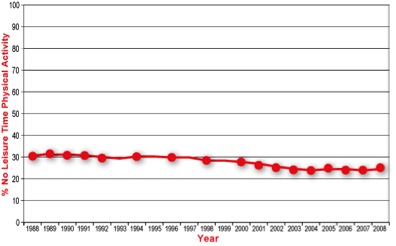
These statistics are a snapshot of just how bad things are. In my next few posts I am going review how much physical activity is “normal” for humans and what can be done about this huge problem. There are many innovative solutions that are working out in the real world, so there is no need to “sit around” and wait for them to happen.
Should Physical Inactivity Be Medicalized?
The Olympics showed us all the amazing things humans can do as a result of intense training on top of talent. While performances in the Olympics and other sporting events get better and better the sad reality is that the world as a whole is getting less fit and less active. Here is a link to a statistics filled analysis of the inactivity pandemic that appeared in the Lancet medical journal just before the Olympics.
This paper was part of a series of articles on physical inactivity and what to do about it. The article points out that “inactive people would gain 1.3–3.7 years (of life expectancy) from age 50 years by becoming active” and that “with elimination of smoking, life expectancy at age 50 years was estimated to increase by 2.3–2.5 years in the US population”.
These data are consistent with the idea physical inactivity now rivals smoking as a cause of premature death. Inactivity is also perhaps the major cause of non-communicable diseases worldwide. In fact regular exercise or even just building more activity into your daily routine can be used to either prevent or treat all sorts of things including:
- Diabetes
- Hypertension
- Coronary artery disease and other forms of atherosclerosis
- Aging associated frailty
- Obesity
- Depression
- Fibromyalgia, Chronic Fatigue Syndrome and POTS.
The figure below shows just how protective physical activity is. The data are from about 4,000 middle aged men in Great Britain, but all sorts of studies in all sorts of populations have essentially generated curves that look just like this. The important thing to note is that most of the protective effects of physical activity occur when people go from inactive to moderately active.
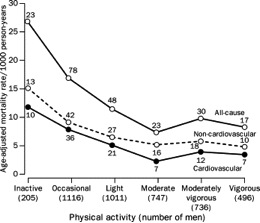
The question now is what to do about all of this inactivity? In a recent editorial on a form of orthostatic intolerance (light headedness and fainting when standing up) I pointed out that, like so many other medical conditions, exercise training appears to make this condition better. I then argued that inactivity should become an official medical diagnosis. This would raise awareness of the problem, improve physician training related to exercise, and perhaps stimulate organizations that pay for medical care to do more. It might also lead to more widespread support of supervised progressive training or “reconditioning” programs and related public health measures.
These ideas are not new, and in fact Dr. Frank Booth, a truly visionary scientist, has been making similar arguments for many years.
Finally forget mortality and the cold hard statistics mentioned above, and ask yourself how many people are leading limited lives because they are unfit, frail, or suffer from preventable chronic diseases? How many older people can’t chase their grandchildren around the yard? How many people can’t go for a hike on beautiful but challenging mountain trail or body surf at the beach? It is a big world and being fit makes it possible to engage fully in the many interesting things that are out there and waiting for us.
You are currently browsing the archives for the Current Events category.
LIKE MIKE

SUBSCRIBE TO RSS
